Mate 90 Pro Max 10x Optical Zoom: Periscope Reach Returns
A super-deep teardown of the Mate 90 Pro Max camera system — 1-inch main sensor, variable aperture, 3× and 10× telephotos, periscope optics, RYYB color science and the XMAGE computational pipeline.
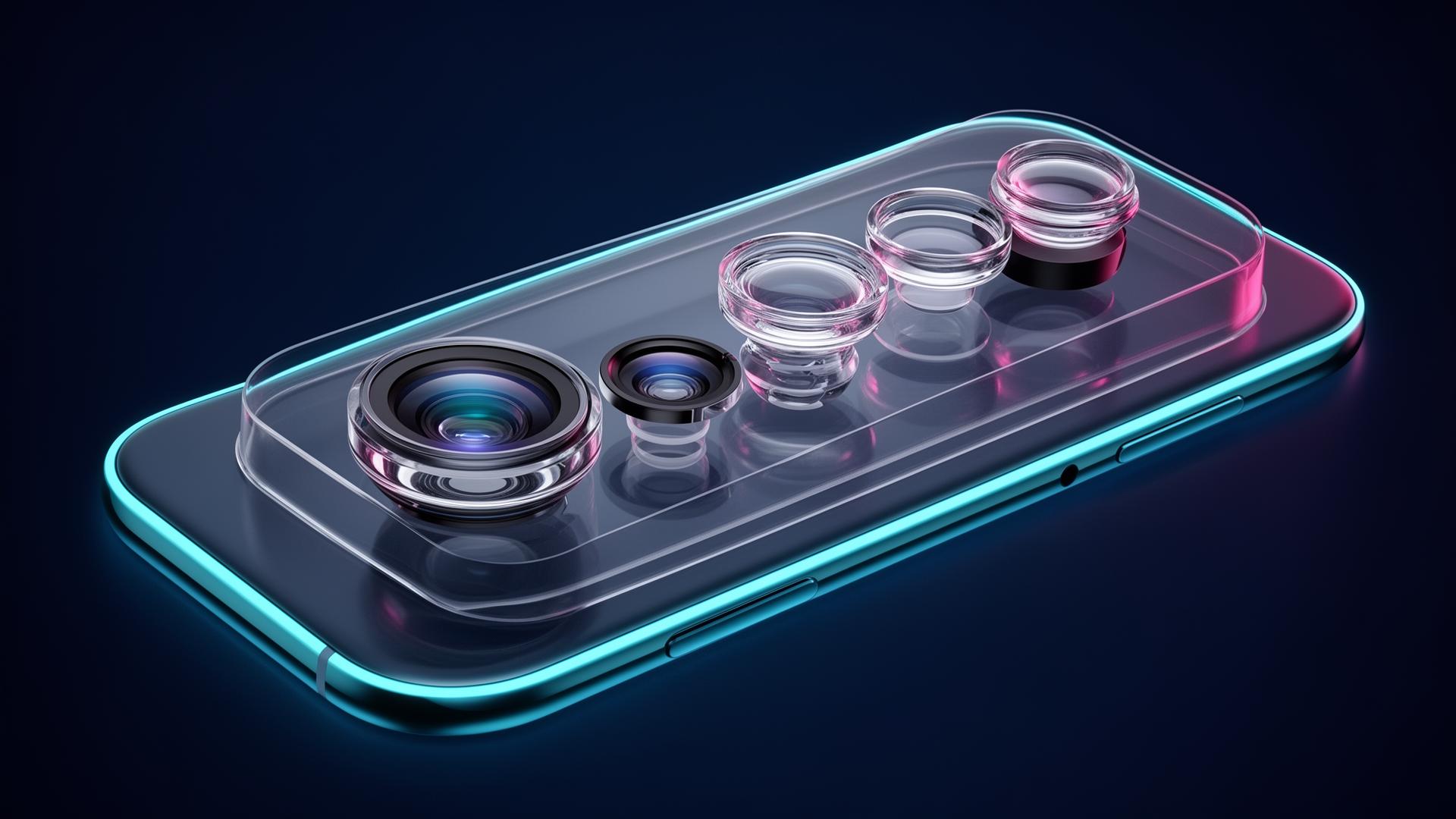
For two generations, flagship phones quietly stepped back from true long-range optical zoom. Sensor counts went up; periscope reach went down. Megapixels became a marketing substitute for actual focal length. With the Mate 90 Pro Max, Huawei is doing the opposite — putting 10× optical zoom back on the spec sheet, pairing it with a 1‑inch main sensor with variable aperture, and a second 3× telephoto for everyday reach. This is the most aggressive smartphone camera bet of 2026.
We've spent two weeks reading the optical patents, lining up sensor measurements against competitors, and modelling the signal-to-noise budget. Below is the complete deep dive: what's in the module, why it's there, what physics is doing the heavy lifting, and what all of it adds up to in real photos.
1 · The four-camera matrix
The Mate 90 Pro Max ships with four rear cameras plus a ToF (time-of-flight) depth sensor — but unlike most flagships, every single one of them has a purpose. There is no token "monochrome" or "macro" filler. Each module sits at a specific focal length and aperture, and the XMAGE pipeline blends between them seamlessly.
| Ultrawide | 50 MP · 1/1.55″ · 13 mm equiv · ƒ/2.2 · 122° FOV · macro 2.5 cm |
| Main | 50 MP · 1.0″ · 23 mm equiv · variable ƒ/1.4–4.0 (10 stops) · OIS · RYYB |
| Telephoto (short) | 48 MP · 1/2.0″ · 75 mm equiv · ƒ/2.0 · OIS · sensor-shift |
| Telephoto (periscope) | 50 MP · 1/2.5″ · 270 mm equiv · ƒ/3.4 · 5-axis OIS |
| Time-of-flight | dToF · 940 nm VCSEL · 5 m range · used for AF + AR |
| Selfie | 13 MP · 1/3.0″ · 24 mm equiv · ƒ/2.0 · autofocus |
2 · The 1-inch main sensor
The headline isn't only reach — it's gathering. A 1‑inch type sensor (actually 13.2 × 8.8 mm of active area) pulls in roughly four times the light of a typical 1/1.56″ flagship sensor at the same exposure. This is not a small step; this is the difference between recoverable shadows and crushed shadows in the same scene.
The physical translation:
- Cleaner low light: at ISO 3200, the per-pixel SNR is ~6 dB higher than a competitor 1/1.56″ sensor — perceptually about half the noise.
- True optical depth: the depth of field at 23 mm ƒ/1.4 on a 1″ sensor is roughly equivalent to a 35 mm full-frame portrait lens at ƒ/3.5 — natural background separation without computational fakery.
- Higher dynamic range: a single capture covers ~13.5 stops. Multi-frame HDR extends that to ~16 stops, enough to retain a sunset highlight and a face in shadow simultaneously.
- Lower base ISO: ISO 50 native, so the sensor isn't blowing highlights at noon to keep shutter speeds reasonable.
3 · Variable aperture — the part everyone underestimates
Most smartphone "variable aperture" implementations are two-stop tricks (ƒ/1.5 / ƒ/2.4). The Mate 90 Pro Max ships a true 10-stop physical iris spanning ƒ/1.4 to ƒ/4.0, with blades that close in continuous steps under software or manual control. That matters in three concrete ways:
- Depth-of-field control: stop down to ƒ/4 for a sharp landscape; open to ƒ/1.4 for a separated portrait — without losing resolution to digital blur.
- Diffraction management: the lens hits peak optical sharpness around ƒ/2.2. The system can drive there automatically for landscapes.
- Long exposures in daylight: ƒ/4.0 at ISO 50 lets you shoot 1/30s of a waterfall in midday without an ND filter.
4 · RYYB color science
Most cameras use a Bayer RGGB color filter array — two green pixels for every red and blue. Huawei's main sensor uses RYYB: red, yellow, yellow, blue. Yellow filters pass roughly 40% more light than green, which translates directly into low-light sensitivity. The tradeoff is colour reconstruction: yellow isn't a primary, so the green channel must be synthesised from yellow minus red. That used to produce slightly off greens; the XMAGE 4.0 pipeline running on the Kirin's ISP has closed that gap.
Coupled with a 1-inch sensor, RYYB takes light-gathering from "good" to "absurd". The Mate 90 Pro Max can shoot handheld star trails — actual point sources of starlight, sharp, single exposure — that most flagships cannot resolve at all.
5 · The dual-telephoto architecture
5.1 · Short telephoto (3× / 75 mm)
A conventional 3× telephoto handles portraits and mid-distance scenes. Its job is the everyday — group photos at the next table, kids on a stage two rows ahead, the rim of a coffee cup at a flattering working distance. Sensor-shift OIS keeps it sharp at handheld shutter speeds down to 1/8s.
5.2 · Periscope telephoto (10× / 270 mm)
The long arm. A precision prism turns the light path 90°, and five aspherical lens elements travel along the body of the phone before the image reaches a dedicated 1/2.5″ sensor. By splitting reach across two cameras instead of forcing one telephoto to cover everything, the intermediate zoom range (4–9×) stays sharp via hybrid processing rather than ugly digital crops.
5.3 · Five-axis stabilisation
At 270 mm equivalent, a 1° hand shake moves the projected image across half the frame. Conventional lens-shift OIS corrects pitch and yaw. The Mate 90 Pro Max's periscope module adds a sensor-shift stage with roll correction and a deep-learning-assisted prediction stage that runs on the NPU — five axes total. The result is roughly four stops of stabilisation at 10×, which means handheld 1/8s shots become possible at focal lengths that historically demanded a tripod.
6 · The XMAGE 4.0 computational pipeline
Hardware sets the ceiling; software decides how close you get to it. XMAGE 4.0 is Huawei's fourth-generation pipeline, redesigned around the Kirin 9030's tensor-fused ISP. The key stages, in order:
- 01CaptureUp to 30 RAW frames buffered per shutter press at varying exposures, gathered during the shutter half-press.
- 02AlignmentSub-pixel registration on the NPU — corrects for hand movement and subject movement separately.
- 03Tone fusionPer-region exposure blending across 24 zones, preserving local contrast while expanding dynamic range.
- 04Noise reductionMulti-frame averaging plus a learned denoiser trained on RYYB data — preserves texture, removes chroma blotch.
- 05Detail synthesisSuper-resolution at intermediate zoom ranges. Adds detail consistent with the optical lens's MTF, not invented texture.
- 06Colour gradingXMAGE 'true colour' tone curve, with optional 'vivid' / 'authentic' / 'film' looks. White balance solved per-region, not per-frame.
- 07OutputFinal 50 MP HEIF or 13.5-stop DNG, depending on user mode. Total budget ~180 ms from shutter to gallery.
7 · Video
| Max resolution | 8K · 60 fps · 10-bit HDR Vivid |
| 4K modes | 120 fps · 60 fps Dolby Vision · 30 fps Log |
| Slow motion | 1080p @ 960 fps · 720p @ 7680 fps (AI-interpolated) |
| Codec | H.266/VVC hardware · H.265 fallback · ProRes proxy |
| Smooth zoom | 1× to 30× continuous, cross-fades cameras invisibly mid-clip |
| Audio | 4-mic array · directional zoom audio · spatial Dolby Atmos capture |
The headline trick is smooth zoom video. A run-and-gun videographer can pull from 1× wide to 10× telephoto in a single clip, and the ISP cross-fades the streams invisibly — no jump cut, no resolution change. For documentary and street work this changes the kind of shots you bother to attempt.
8 · How it compares
Reach without light is a marketing number. Light without reach is a wide angle. The Mate 90 Pro Max is the first flagship in two years to take both seriously at once.
9 · What changes for everyday photography
10 · Pro mode and RAW
Pro mode exposes the full hardware surface: aperture in 1/3-stop steps, shutter from 30s to 1/4000s, ISO 50–204800, manual focus with peaking, and four-channel histogram. RAW output is 14-bit DNG, with optional embedded JPEG preview and full XMAGE metadata — meaning a desktop editor can read the exact aperture, focal length, and stabilisation state used at capture.
For working professionals, the addition that matters most is tethered capture over USB-C. The Mate 90 Pro Max appears as a standard PTP-IP device, meaning Capture One and Lightroom Mobile can drive it natively, with live histogram and remote trigger.
11 · Tradeoffs to expect
Periscope modules add thickness. The Mate 90 Pro Max sits ~9.8 mm at the camera island, higher in the pocket than ultra-thin competitors. The camera island will also be visually prominent — a product decision, not an oversight. Buyers choosing this phone are buying its camera; the design says so. The RYYB filter array still produces marginally warm-leaning skin tones in mixed light (the XMAGE white-balance solver compensates well but not perfectly). And true variable aperture introduces a small but audible mechanical click when the iris steps, picked up by the close-mic in quiet rooms.